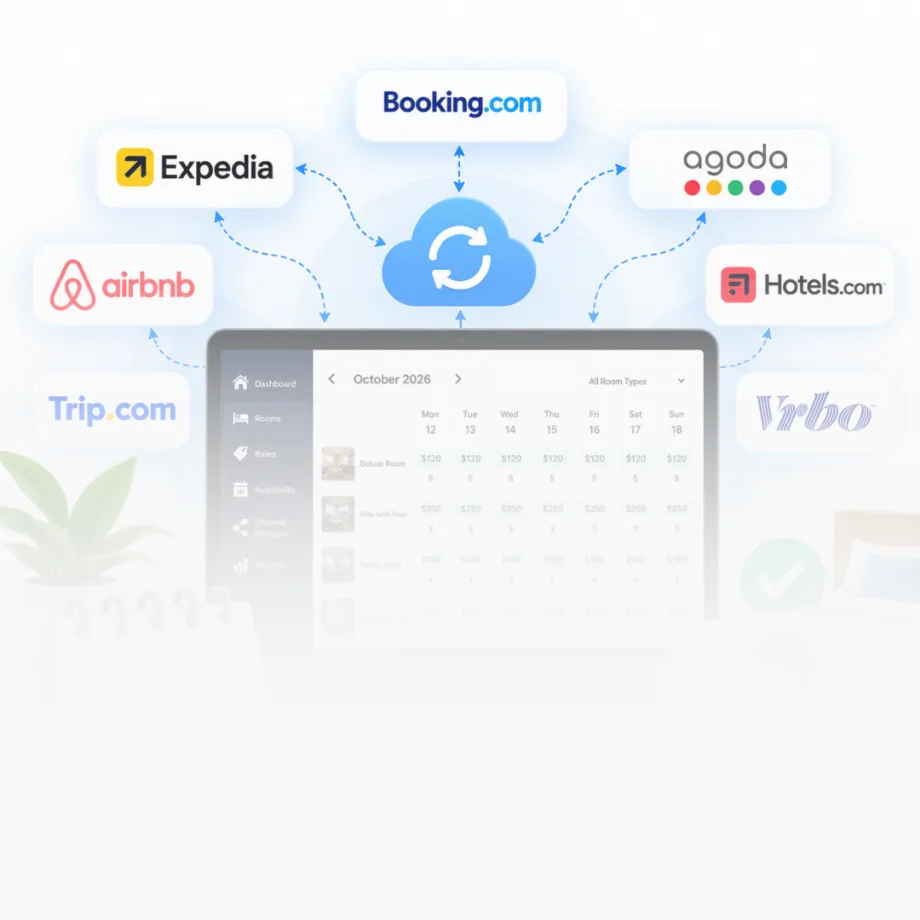

Every villa or hotel that sells through Booking.com, Agoda and Airbnb eventually hits the same question: who should actually be doing this work?
There are three answers. Do it yourself, hire an in-house e-commerce manager, or use outsourced OTA management, usually a part-time OTA manager from an agency. None of them is right for every property. Here is an honest comparison, so you can pick the one that fits yours.
The short comparison
| Do it yourself | In-house hire | Outsourced OTA manager | |
|---|---|---|---|
| Cash cost | None extra | Full salary, benefits, training | Monthly fee or a percentage |
| Your time | High, every day | Low, but needs supervising | Low: you read a report |
| Expertise | Yours | One person's | Built across many properties |
| Sick leave, holidays, resignations | Work stops | Work stops | A team covers |
| Closeness to operations | Closest | Close | Needs regular contact |
| Control | Full | Full | Stays with you, if the contract is right |
When doing it yourself makes sense
- A small property, one to a few units, on one or two OTAs.
- You have time every day and enjoy the work.
- Bookings are steady and you know which channel pays best after commission.
If that's you, the best investment is learning to keep your listings sharp. Our guide to villa marketing in Bali is a good place to start.
When to hire in-house
- A hotel large enough that the OTA work is a genuine full-time job.
- The role mixes with other on-site work: reservations, front office, guest communication.
- You're ready to train, supervise, and cover holidays and departures.
The biggest risk is depending on one person. When they leave, what they knew about pricing, OTA contracts and your guests often leaves with them. Keep every account in the property's name, and write the processes down.
When to outsource
- A small to mid-sized villa or hotel that needs real expertise, but not a full-time salary's worth of work.
- Owners who live outside Bali, or abroad, and need clear reporting.
- Properties that rank below competitors and don't know where to start.
- Small groups with several properties that want one way of working across all of them.
The main advantage is experience that already exists. A team managing many properties spots patterns sooner: when pickup is slowing, which promotions actually work in a given area, and which platform changes are worth getting ahead of.
A mix is often the best answer
Plenty of properties split the work. Staff on site handle what needs someone physically there: guest messages, check-in, fresh photos after a renovation. An outsourced OTA manager handles pricing, listings, strategy and reporting. Each side does what it's best at.
Questions to ask an OTA management service
- Do the accounts stay in my property's name? This one is not negotiable.
- Who decides the price, and what's the floor?
- What's in the report, and how often does it come?
- How many OTAs are covered, and are content and review replies included?
- What happens if we stop? The notice period and the handover.
Be wary of anyone who guarantees a number-one ranking or a fixed occupancy. Nobody controls the OTAs' algorithms. What anyone can promise is consistent work and honest reporting.
A quick way to decide: count the hours a week you spend on OTAs, then ask yourself two things. Would that time be worth more somewhere else in the business? And are the results as good as they should be? If the answer to both is no, it's time to get help.
Want to know exactly what an OTA manager does day to day? Read what does an OTA manager do, or see how our villa OTA manager service works.